The Architecture of Invisible Power
Red Blood Journal · October 2026 · Long-form investigation
Introduction — The Institutions That Outlived Empires
History is filled with kings who believed their kingdoms would last forever, emperors who imagined their authority was permanent, and governments that promised to create a new political order. Yet dynasties disappeared, borders shifted, empires collapsed, and political ideologies rose and fell. Through these transformations, certain institutions demonstrated an extraordinary ability to survive.

Three such institutions deserve particular attention: the City of London, the Holy See and Vatican City, and the Sovereign Military Order of Malta. Each emerged from a different historical environment, developed a distinctive relationship with political power, and preserved unusual institutional privileges across centuries of upheaval. Their origins, legal status, and purposes differ considerably, but all three offer insights into how authority can endure beyond the governments surrounding it.
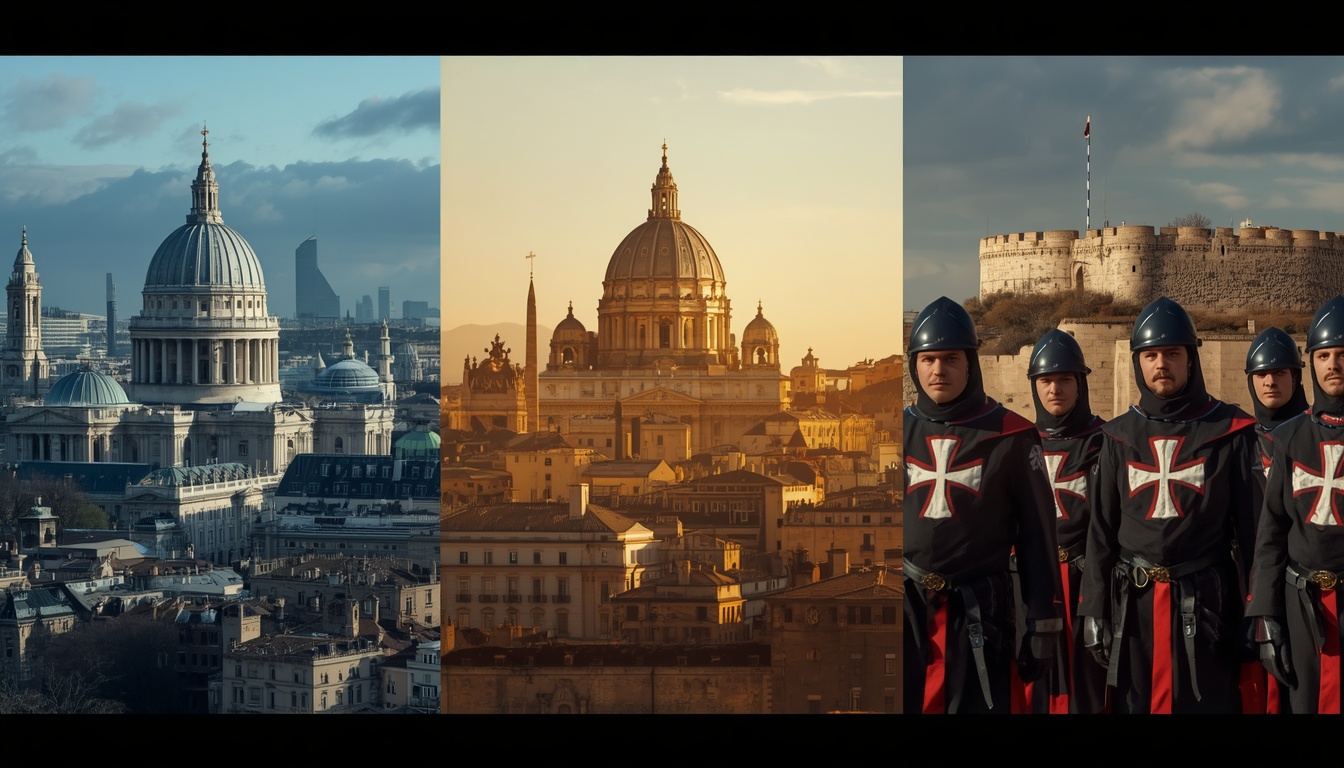
The City of London developed from a Roman commercial settlement into an international financial center with its own historic municipal government. The Holy See evolved from the leadership of an early Christian community into an institution exercising religious, diplomatic, and, at various points, territorial authority. The Sovereign Military Order of Malta began as a charitable hospital in Jerusalem, became a military and territorial power during the Crusades, and eventually transformed into a humanitarian and diplomatic organization without conventional sovereign territory.
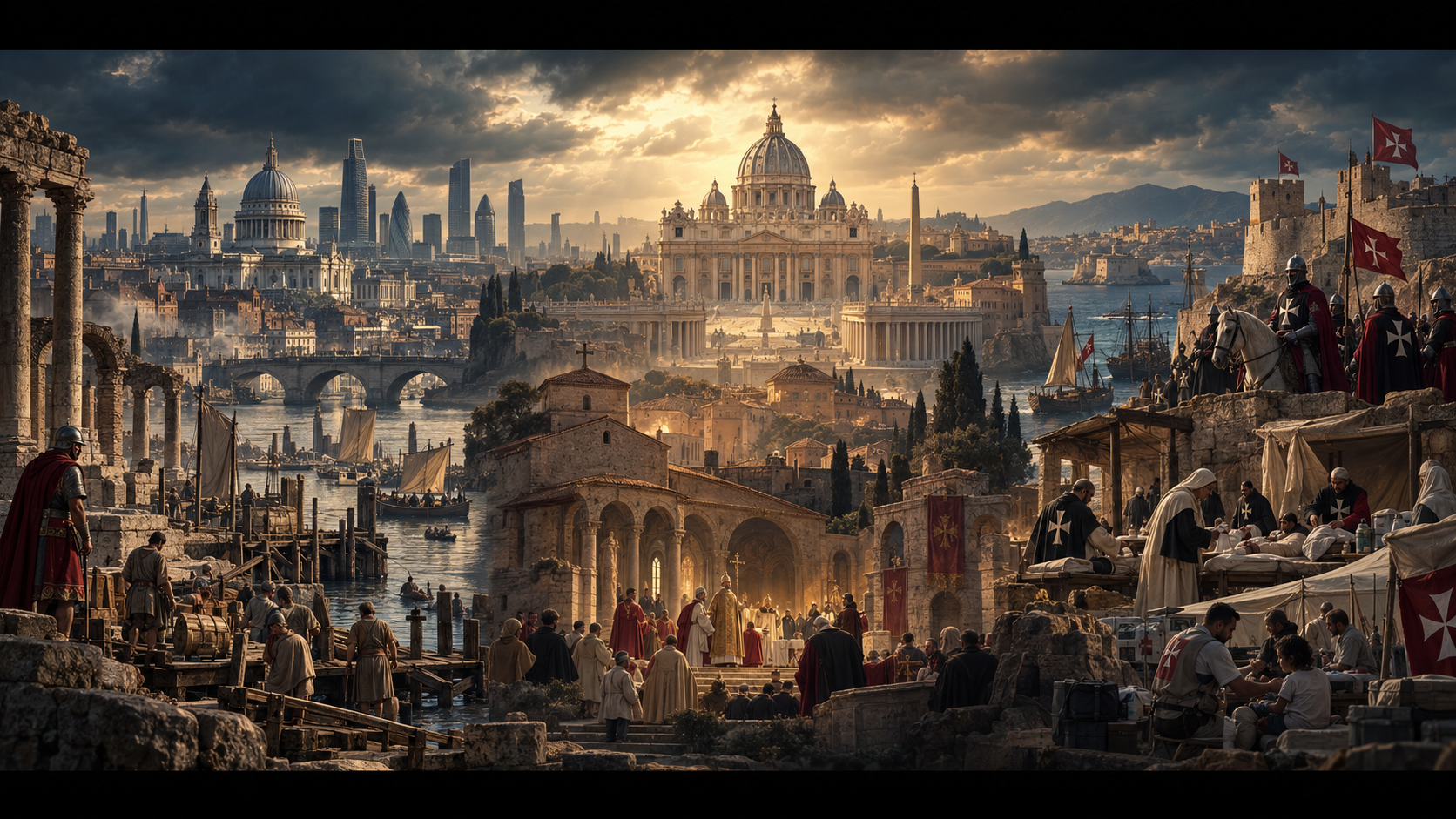
These histories raise an intriguing question. If political administrations change while certain institutional networks persist, how much effective power belongs to elected governments, and how much is exercised through enduring structures of finance, religion, diplomacy, law, and organized influence?

This is where the controversial concept of the deep state enters the discussion. The term is frequently used without a consistent definition, sometimes describing genuine networks operating beyond democratic oversight and sometimes serving as an all-purpose explanation for political events. A serious investigation must resist both the temptation to dismiss every possibility of concealed influence and the equally dangerous temptation to mistake historical connections for proof of a coordinated conspiracy.

The objective is not to establish that these three institutions secretly govern the world. It is to examine the mechanisms through which their influence has developed, the interests they have historically protected, and the conditions under which overlapping networks could exercise power outside ordinary public accountability.

I. Defining the Deep State: Beyond the Language of Conspiracy
Before examining the institutions, it is necessary to distinguish the ordinary persistence of government from the existence of an organized deep state.
Modern countries depend on permanent institutions. Civil servants, military officers, intelligence professionals, judges, regulators, central bankers, and administrative agencies commonly remain in place when elected leaders depart. Such continuity is often essential to the functioning of government. It allows legal obligations to be fulfilled, public services to continue, and specialized knowledge to survive political transitions.
An institutional bureaucracy is therefore not automatically a deep state. A more meaningful use of the term refers to networks of officials and associated private actors who exercise coordinated political power outside authorized democratic control, particularly when they act covertly to preserve their interests, obstruct lawful decisions, or manipulate political outcomes.
The distinction is fundamental. An institution may possess enormous influence without operating illegally, and powerful individuals may share interests without belonging to a secret organization. Conversely, history contains documented examples of clandestine political coordination, unlawful intelligence operations, corruption, and unofficial networks manipulating public institutions.
The central investigative challenge is determining where legitimate influence ends and covert control begins.
For Red Blood Journal, the appropriate method is to examine conduct rather than declarations. Institutions should be assessed through observable decisions, financial arrangements, legal privileges, conflicts of interest, and measurable consequences. Official explanations deserve examination, but skepticism must apply equally to allegations made against those institutions.
II. The City of London: Financial Power Without National Sovereignty
The City of London, commonly known as the Square Mile, occupies a small territory within Greater London. Its distinctive municipal institutions trace their origins to the medieval period, while its urban history reaches back to Roman Londinium.
Its historical importance is not primarily geographical. It is institutional and economic.
Over centuries, London's merchants, guilds, banking houses, insurers, and trading organizations helped develop systems that connected private capital to international commerce and government finance. The growth of the British state and empire was closely connected to London's ability to organize credit, insure maritime ventures, finance trade, and support public borrowing.
The establishment of the Bank of England in 1694 was particularly significant. It strengthened the machinery through which the English government could obtain large-scale financing, including for war. Although the Bank of England was nationalized in 1946 and is not owned by the City of London Corporation, its historical emergence illustrates the close relationship between organized capital and the development of modern state power.
The City Corporation itself retains distinctive governing arrangements, including a business-vote system for qualifying organizations and the office of the Remembrancer, whose responsibilities include monitoring parliamentary legislation and representing the City's institutional interests.
These arrangements are publicly documented, not secret. Nevertheless, they raise legitimate questions about representation, privileged access, and the relationship between concentrated economic interests and democratic institutions.
The City is not an independent sovereign nation, nor does its municipal government control every financial institution operating within its boundaries. The global influence of London finance should not be confused with the powers of the City Corporation. Many corporations, investors, regulators, banks, and markets operate through separate legal entities with different interests.
Still, the broader financial ecosystem illustrates a central political reality: governments that depend upon borrowing, investment, liquidity, and financial stability must take the responses of major financial actors seriously. Those actors can influence policy without possessing the formal authority to issue orders to an elected government.
The critical question is whether this influence operates through accountable public processes or whether certain decisions are shaped through relationships inaccessible to ordinary citizens.
III. The Vatican: Spiritual Authority, Political Legitimacy, and Diplomatic Continuity
The Holy See represents a substantially different form of institutional power.
Its influence developed from its role in the leadership of Christianity and grew as the papacy acquired religious authority, property, political relationships, and territorial responsibilities. From the establishment of the Papal States in the eighth century until the nineteenth century, popes exercised government over substantial territories in central Italy.
The papacy negotiated with monarchs, participated in conflicts, influenced ecclesiastical appointments, and developed diplomatic systems that long predated many modern nation-states.
The Vatican's modern sovereignty emerged from the Lateran Pacts of 1929, negotiated between the Holy See and the Italian government under Benito Mussolini. The agreements established Vatican City as a sovereign state and provided a financial settlement intended to resolve the longstanding dispute over the loss of papal territory.
The significance of this arrangement extends beyond the relatively small territory involved. Vatican City guarantees the Holy See a degree of territorial independence, while the Holy See maintains a separate and longstanding international legal personality through which it conducts diplomacy.
The Catholic Church also possesses a global network of dioceses, religious orders, charitable institutions, educational organizations, and affiliated institutions. These networks are not a single centrally owned commercial enterprise, and the pope does not personally control all Catholic institutional assets. Nevertheless, they create channels through which moral authority, information, organizational resources, and diplomatic relationships can operate internationally.
The Vatican's history includes both humanitarian achievements and well-documented abuses of institutional power. Financial scandals, failures of accountability, political accommodations, and efforts to protect organizational reputation demonstrate why concentrated religious authority requires scrutiny just as financial and political authority do.
The relevant question is not whether the Vatican secretly directs all Catholic institutions or foreign governments. Such sweeping claims are unsupported. The more productive question is how religious legitimacy and diplomatic access have influenced specific political decisions, and whether those relationships have sometimes protected institutions or individuals from appropriate accountability.
An organization need not direct governments to affect their behavior. Its influence may arise from the ability to confer legitimacy, mobilize constituencies, negotiate agreements, and shape the moral or political framing of public issues.
IV. The Sovereign Military Order of Malta: Influence Beyond Territory
The Sovereign Military Order of Malta presents the most unusual case of the three.
Its origins lie in a hospital established for pilgrims in Jerusalem during the eleventh century. Recognized by Pope Paschal II in 1113, the Order gradually developed military responsibilities during the Crusades, eventually governing territories on Rhodes and then Malta.
During its territorial centuries, it maintained armed forces, controlled fortifications, administered revenues, cultivated relationships with European rulers, and participated in Mediterranean military and commercial affairs.
Napoleon's conquest of Malta in 1798 ended its territorial government. Yet the Order survived, ultimately establishing its headquarters in Rome in 1834 and rebuilding its mission around medical assistance, humanitarian relief, and social services.
Today, the Order maintains diplomatic relations with numerous states and possesses a distinctive international legal personality, even though it does not govern an ordinary sovereign territory. Its headquarters in Rome enjoy particular protections, but these arrangements do not make the premises an independent country comparable to Vatican City.
The Order has historically maintained connections with European noble families and Catholic elites. Its traditions, ceremonial structure, and membership networks can appear mysterious to outsiders, particularly when viewed alongside its unusual diplomatic status.
However, aristocratic associations, restricted membership categories, and diplomatic privileges do not establish the existence of a clandestine political command structure. Such a conclusion would require specific evidence of hidden coordination, political interference, financial transfers, or unlawful operations.
There is also a fundamental limit to the claim that the Order functions as a completely independent center of power. It remains a Catholic religious order, and Pope Francis exercised substantial authority over its internal governance during the constitutional reforms of 2022.
The Order is therefore best understood as an institution with a special international position and historical elite connections, rather than a fully independent sovereign government exercising unrestricted authority.
Its historical significance lies in demonstrating that diplomatic recognition, international relationships, and institutional continuity can preserve influence even after territorial power disappears.
V. The Shared Architecture: What Actually Connects the Three?
The most interesting similarities are structural rather than ceremonial. All three developed distinctive legal arrangements, maintained relationships with powerful actors, acquired or administered resources, and adapted to changing political conditions without losing their institutional identities.
Their common features suggest that institutional continuity can be a source of influence. They do not prove that the three organizations coordinate their activities, share a central leadership, or pursue a unified political agenda.
The distinction between institutional similarity and organizational cooperation is essential. Banks, religious institutions, and humanitarian organizations can maintain international networks without belonging to one governing system. Likewise, wealthy families may have historical relationships with several institutions without possessing operational control over them.
A genuine investigation must identify particular individuals, transactions, decisions, and relationships rather than treat overlapping histories as sufficient evidence of hidden authority.
VI. Three Possible Models of Power
There are three principal ways to interpret the enduring influence of institutions such as these.
The first model is independent institutional self-preservation. Each institution develops mechanisms to defend its mission, financial resources, legal privileges, and political relationships. Its leadership learns how to negotiate with changing governments because survival requires adaptation. Similar behavior among institutions may reflect similar incentives rather than secret coordination.
The second model is overlapping networks of influence. Financial institutions, religious authorities, diplomats, political leaders, charitable organizations, and elite social networks can share individuals, interests, and professional relationships. Cooperation may occur informally through personal connections or formally through lobbying, agreements, investments, or joint initiatives. Some arrangements may be transparent, while others may be difficult for the public to examine.
The third model is a centralized clandestine system. Under this hypothesis, a hidden coordinating group directs multiple institutions and uses their combined networks to influence governments, markets, wars, or political succession according to a common strategy.
The first model is strongly supported by historical evidence, and the second is consistent with known patterns of elite interaction. The third remains an unproven hypothesis in relation to these three institutions.
It is important to recognize that outcomes can appear coordinated even when no central authority exists. Financial institutions may respond similarly to economic incentives, governments may adopt comparable policies under shared pressures, and diplomatic organizations may pursue overlapping interests without taking instructions from a common leadership.
To distinguish these explanations, investigators must establish not only that the same result occurred but also how decisions were made and whether deliberate coordination can be demonstrated.
VII. The More Important Question: Who Governs When Governments Change?
One of the most consequential observations from this comparison concerns the difference between political office and enduring institutional influence.
Elected officials normally serve limited terms. Political parties rise and decline, ministers leave office, and governments reverse their predecessors' policies. Meanwhile, financial arrangements, international treaties, institutional property, professional bureaucracies, and longstanding organizational relationships may persist for generations.
This does not make every permanent institution illegitimate. Modern civilization depends upon continuity. Legal systems, hospitals, scientific institutions, and public infrastructure cannot be rebuilt after every election.
The danger emerges when continuity becomes insulation from accountability.
Consider a government that depends heavily on financial markets to finance public debt. Its elected officials possess formal legal authority, but some available choices may carry substantial economic consequences. Investors need not issue secret instructions to influence policy. Governments may anticipate how markets will respond and adjust their decisions accordingly.
Religious and diplomatic influence can operate through comparable, although different, mechanisms. Governments may value religious legitimacy, international recognition, humanitarian cooperation, or access to established networks. These relationships can affect decisions without requiring an organization to exercise direct command.
The result is that political power may be distributed among elected governments and numerous actors with independent sources of influence. Some of that influence is visible and lawful, some is poorly disclosed, and particular activities may cross into corruption or unlawful interference.
Understanding those distinctions is more valuable than reducing the entire political system to an unidentified group of hidden rulers.
VIII. Following the Money, the Decisions, and the Consequences
If the objective is to determine whether covert political networks exist around these institutions, the inquiry should proceed through evidence rather than symbolism.
The first area of investigation is institutional leadership and overlapping membership. Researchers should identify individuals who held influential positions across governing bodies, financial institutions, diplomatic networks, private companies, and charitable organizations. Shared membership establishes a relationship, but additional evidence is required to demonstrate coordinated conduct.
The second area is financial activity. Public records, financial statements, beneficial ownership filings, government contracts, property transactions, loans, and significant donations may reveal dependencies or common economic interests. Transactions should be examined in their historical and legal context rather than treated as suspicious merely because prominent individuals are involved.
The third area is political decision-making. Parliamentary proceedings, legislative proposals, diplomatic correspondence, lobbying disclosures, meeting records, and official archives can reveal how particular decisions developed. When a policy appears to benefit a concentrated interest, the relevant questions are who proposed it, who advocated for it, what evidence influenced the decision, and who received the resulting benefits.
The fourth area is institutional protection. Cases in which governments shielded powerful individuals, obstructed investigations, granted exceptional privileges, or declined to enforce existing rules warrant scrutiny. Such episodes may provide evidence of corruption, regulatory capture, or improper influence, but each allegation must be established independently.
The fifth area is measurable human consequence. An investigation should not end with discovering that powerful people know one another. It should explain whether their decisions affected public finances, personal rights, economic opportunity, access to justice, international conflict, or the distribution of wealth.
This approach allows the evidence to determine whether a pattern reflects legitimate cooperation, concentrated political influence, regulatory capture, or covert wrongdoing.
IX. What the Evidence Supports — and What Remains Unproven
The historical record supports the conclusion that all three institutions have maintained unusual forms of continuity and relationships with political, religious, or economic elites. It also establishes that they possess distinctive privileges and international networks, although their actual governing authority differs substantially.
It is reasonable to investigate whether individuals or organizations connected to these institutions have participated in improper political influence. It is equally reasonable to examine how financial dependence, diplomatic access, religious authority, and elite relationships may shape government behavior.
What the evidence does not establish is that the City of London, the Vatican, and the Sovereign Military Order of Malta operate as three branches of a single secret global government.
Nor does the existence of institutional privileges demonstrate that these organizations collectively control central banks, national governments, military forces, or international political events.
Those are specific, far-reaching allegations. They require specific and substantial proof.
The strongest current conclusion is that modern political power operates through relationships between formal government authority and influential institutions that may be older, wealthier, or more internationally connected than particular elected administrations.
Whether any particular network crosses the line into covert and unlawful control remains a question for documentary investigation, not assumption.
X. The Red Blood Perspective — Do Not Confuse the Face With the Machinery
History encourages people to focus on the visible figures standing at the front of the political stage. Kings, presidents, prime ministers, religious leaders, and generals become the recognizable symbols of authority. Their speeches attract attention, their conflicts dominate the news, and their personalities become the subject of public debate.
Yet visible leadership is only one part of any political system. Institutions operate through laws, finances, contracts, personnel, information, organizational incentives, and established relationships. These structures may continue functioning long after a celebrated leader has departed.
The City of London, the Vatican, and the Sovereign Military Order of Malta demonstrate different ways institutional identities can survive dramatic historical change. Their endurance should provoke inquiry into the conditions that sustain power, not automatically establish that they are controlled by one hidden authority.
The Red Blood method is to examine the machinery behind public events. When leaders announce a policy, ask who drafted it and who stands to benefit. When governments borrow money, investigate the financing arrangements and their consequences. When institutions receive exceptional treatment, examine the legal basis and the interests served. When influential people are connected, determine whether those relationships actually affected decisions.
The essential principle is simple: observable actions deserve greater weight than political theater, whether that theater is performed by governments, financial institutions, religious authorities, or those claiming to expose them.
Citizens gain little by replacing unquestioning faith in official explanations with unquestioning faith in conspiracy narratives. Both surrender independent judgment to someone else.
A meaningful investigation should identify mechanisms that can be verified, distinguish evidence from speculation, and remain willing to revise its conclusions when new facts emerge.
The question is not merely whether a deep state exists. It is whether political and economic institutions can accumulate power that citizens cannot adequately scrutinize, challenge, or control.
That problem deserves examination regardless of the label attached to it.
XI. The Ocean of Love and Positivity Perspective — Power Without Consciousness
From the Ocean of Love and Positivity perspective, the central concern is not the age of an institution, the grandeur of its buildings, the titles carried by its leaders, or the wealth it administers. The question is what that institution contributes to human development and what consequences follow when its authority is exercised.
Religious institutions can inspire compassion while also becoming vulnerable to institutional self-protection. Financial institutions can enable cooperation and prosperity while also concentrating economic dependency. Humanitarian organizations can relieve suffering while remaining responsible for examining their own structures of privilege and accountability.
The existence of power is not itself evidence of moral failure. Power becomes dangerous when preserving authority takes precedence over the people that authority is supposed to serve.
History repeatedly demonstrates the consequences of institutions treating their own survival as the highest objective. The temptation to conceal mistakes, protect influential members, defend privileges, or sacrifice outsiders can arise in religious, commercial, and governmental organizations alike.
A more conscious society would not merely search for hidden rulers in the hope that exposing or replacing them would solve every problem. It would develop institutions that can be questioned, audited, corrected, and held accountable, while encouraging individuals to cultivate the independence necessary to recognize manipulation.
Personal sovereignty begins when people refuse to surrender their judgment to political leaders, religious authorities, financial institutions, or popular narratives. It grows through evidence, education, responsibility, compassion, and the willingness to examine uncomfortable truths.
The objective is not revenge against institutions or individuals. It is protection from abuse, correction of harmful structures, restoration of accountability, and prevention of repeated injustice.
Conclusion — The Persistence of Power Is the Real Story
The City of London, the Vatican, and the Sovereign Military Order of Malta have each survived changes that destroyed other powerful institutions. Their histories illuminate different forms of enduring authority: financial organization, religious and diplomatic legitimacy, and international legal recognition.
Their similarities justify historical comparison, and their networks merit careful investigation. They do not, by themselves, prove the existence of a coordinated global deep state.
The more defensible and consequential finding is that power is not confined to the offices occupied by elected leaders. It can also reside in enduring institutional arrangements, economic dependencies, legal privileges, diplomatic relationships, and organized networks whose influence extends across successive governments.
An investigation of such power should follow documents, money, decisions, and consequences until it can identify who exercised influence, through which mechanisms, and to what effect.
The institutions that govern public life should never be regarded as beyond examination merely because they are ancient, respected, wealthy, or legally privileged. But the same standards of proof must apply to accusations made against them.
The greatest danger to democratic accountability may not be a single hidden throne from which the world is ruled. It may be a collection of enduring power structures whose combined influence is difficult for ordinary citizens to see, measure, or challenge.
And the most important response is not blind belief in an alternative narrative. It is an informed public willing to examine the machinery of power for itself.